War Love Stories: How People Dated During World War Two
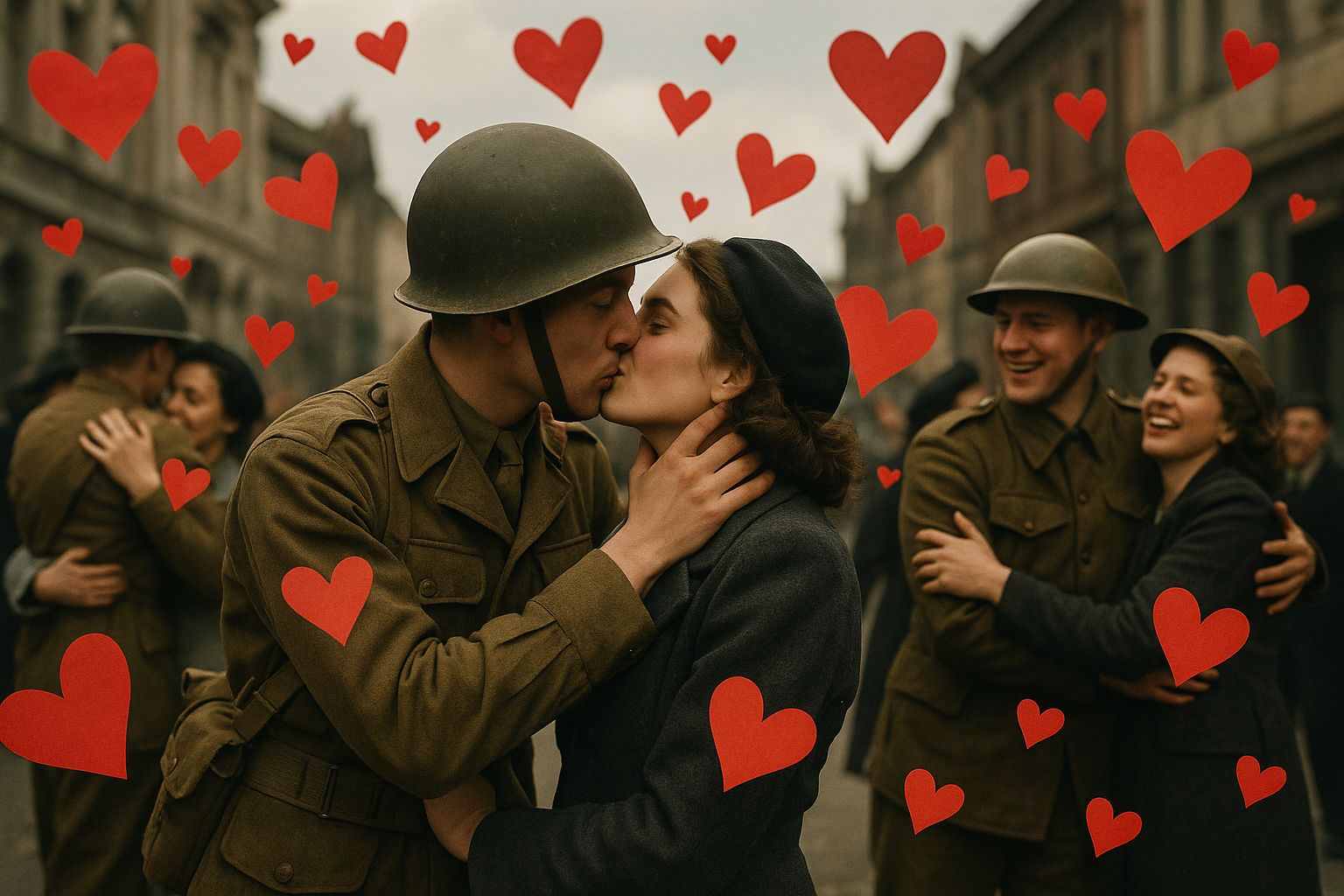
Dating in Europe during WWII
Happy couples dancing - Dating in Europe during WWII
Long before Tinder, Europeans found love in the war trenches, factories and dance halls – often with no meat or sugar to spare. Between blackout curfews and ration stamps, dating had to get creative. Romance became a kind of wartime morale-booster, a brief escape from bombs and boredom.
As one historian notes, WWII was an “emotional watershed” when people shifted away from careful courtship and planning marriages, instead chasing the thrill of romance amid uncertainty.
In practice, the war love stories unfolded by couples meeting “outside the orbit of parents,” mixing freely at new venues like service clubs, pubs or special dances for soldiers.
In short, young people were on their own: the biggest online wingman was actually Uncle Sam’s Army (or Luftwaffe, depending on which side you were on).
Courtship Under Rationing and Curfews
Dinner dates in WWII Europe didn’t involve gourmet meals – food was heavily rationed and even bread loaves carried coupons. Many couples made do with picnics or tea instead of steak, sharing handfuls of rationed sweets or the occasional coffee.
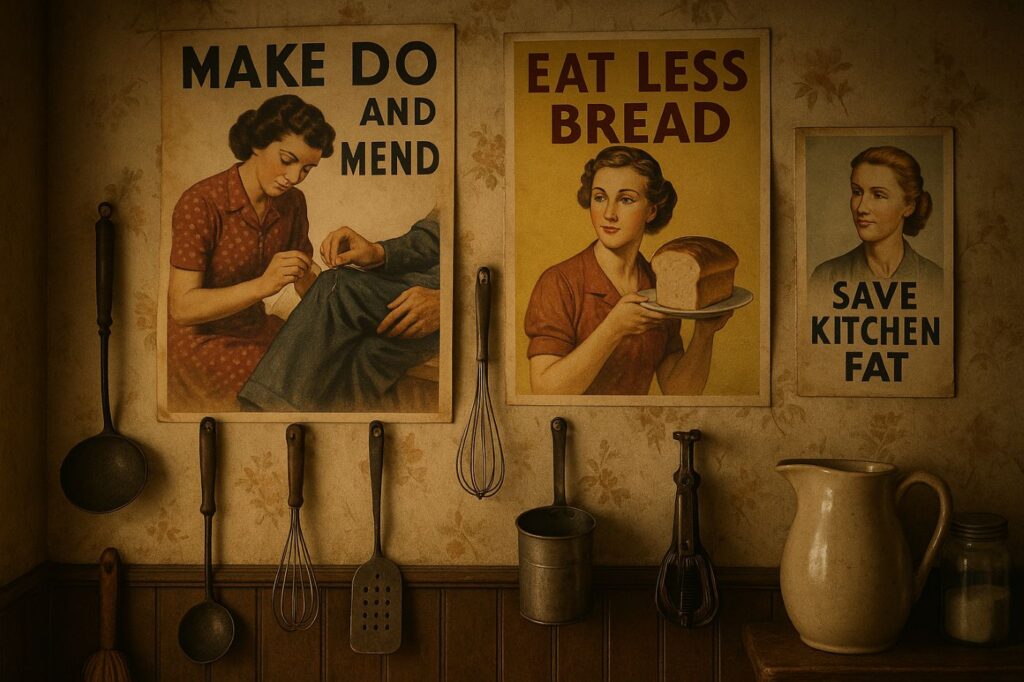
Clothes were rationed too, so a girl’s “new dress” might be a carefully saved pair of coupon points, and make-up was a precious luxury. (The fashion savvy often turned to “Make Do and Mend” to patch up something date-ready.)
Even under these conditions of life during World War Two, love found a way. Some couples would exchange a special portion of their meager sugar ration to brew an extra-strong coffee for two, or burn a single scented candle to set the mood. Officially, every woman – and even every baby – got a ration book, but rebels among the youth learned to stretch them creatively.
For many, the solution was simpler: take advantage of free entertainment. Movie theatres and dance halls weren’t rationed, so a soldier or factory girl might woo a sweetheart over a jitterbug rather than a candlelit dinner.
War ministries encouraged dances as morale boosters, and the giant crowds and live big bands did much to distract people from scarcity. (As one veteran later recalled, at a Manchester dance hall “all the dancers were singing as well as dancing – it almost became community singing – it really did help us all feel more cheerful.”)
Often the only import each girl needed was the right last name – American GIs arriving in Britain had a reputation for generosity and openness.
In Poland or France, where locals survived on far less, even a slice of cake meant a lot. In London, turning a tube ticket into a date night out in the parks or a free outdoor concert was the norm. One can imagine teenagers exchanging winks over the compulsory War Office coffee ration.
Boots on the Dance Floor: Ballroom Blitz and Blitz Spirit
Amid WWII London’s Hyde Park, American soldiers and English sweethearts stole kisses between duties.
The dance floor was the wartime Tinder for many. Night after night in London, Paris or Berlin (before the Nazis closed them), crowds filled ballrooms and open-air dances. In Britain especially, dancing became a patriotic act.
One memoirist noted “the dances were full of uniforms of all nations… it was exciting dancing with the women in uniform” – from English WRENs and ATS girls to visiting Polish and American servicemen. Even as bombs rained, the band often played on. Newspapers gushed about young Britons dancing defiantly through the Blitz.
In Dover, under German shelling, a journalist marveled that dancers “remained swaying to the rhythm of war” and that the “orchestra [would] vie with German gunners as to which could make the most noise”.
These stories bolstered the famous “Blitz spirit,” portraying every waltz and foxtrot as resistance. In fact, dances were touted as unifiers: one report claimed they brought together people of “different classes, regions…and cement[ed] bonds between the British and their military allies, such as Poles or Americans.”.
Dance halls also gave rise to lasting romances. Many war romances began with a stolen dance. A British soldier named John, writing from an RAF base, noted in March 1943 that his “round of good girl dancers is vanishing gradually” as girls shipped out to new jobs or service. The ones left had new accents: “I danced with one who was from Australia and now in service of the WAAF’s (Women’s Auxiliary Air Force)”. He eventually parlayed his leave into dancing at London’s famed Hammersmith Palais – once the war’s “most famous ballroom” – hoping to meet “some good dancers there.”
Throughout occupied Britain, war brides met GIs at dances; Americans in England famously learned the jitterbug from local swing-loving girls. Even the image of crowds sitting under Hyde Park elms, GIs teaching Brits to jitterbug or row in Serpentine boats, was captured by Life Magazine as Allied Cupid in action.
Factory Flings and War-Work Romance
Worksites and barracks swelled the dating pool too. With millions mobilized, young men and women often worked (and flirted) outside their hometowns.
Women in munitions factories, on the Land Army fields or assembling aircraft engines became a significant part of the social scene. Morale-builders included dances on base or at civilian clubs near factories.
Letters and memoirs hint at many a romance igniting on the job: the American “Rosie the Riveter” stereotype had European analogues – British and Soviet factory girls joining “Komsomol” dances with young workers, or Italian women sharing lunches with American GIs building Naples’ docks. Even at home-front workplaces romance was present.
Accounts of UK textile mills or hospitals include subtle references to courtship at tea breaks and wartime weddings in factory chapels. (For example, munitions factories were nicknamed “Canary Girls” – not only from the yellow dye of TNT on their skin, but also for the lively way they worked and socialized.)
War conditions loosened some social barriers: the need for shelter or commuting rides meant classes and regions mixed more, giving earnest couples a little more freedom.
Babies across Enemy Lines and Allied Borders
Wartime also meant international couplings – some encouraged, some forbidden. American and British forces stationed in Europe led to a flood of “war brides.” Estimates suggest roughly 200,000 Continental European women married American GIs, and about 70,000 British women wed American servicemen. (By war’s end the U.S. even changed immigration law to let these brides sail off with their GIs.)
In Britain, an iconic 1944 photo shows a U.S. sergeant and a British ATS lass embracing in Hyde Park . Across liberated Europe, German/Axis women with Allied men was far more taboo, but it happened. After France’s 1940 defeat, many French girls took Reichmarks to buy food, or – willingly or not – fell for German soldiers.
Post-war reckoning was brutal: thousands of “horizontal collaborators” had their heads shaved in public. In fact, horizontal relationships were widespread: historians believe France saw as many as 200,000 babies born to German fathers during the occupation.
Norway, Belgium and other occupied countries had similar stories (Germany has even offered citizenship to these “children of the other bank of the Rhine”).
At the same time, Allied-held territories and co-belligerents offered romances across borders. Poland’s “hometown army” liberated east, and millions of Soviet soldiers returned through German lands – love blossomed in displaced persons camps and trains.
In 1944 Warsaw, dancers at the U.S. Officers’ Club floor fell for Red Army officers and RAF aviators. In Italy after 1943, British and American soldiers often enjoyed dinners or dances with local women (just as German soldiers had before the armistice).
One famous anecdote: singer Marlene Dietrich arranged revues for U.S. troops in Naples, and local Italians formed choirs to serenade the GI audience. Even Italians and Germans, officially enemies, mixed in neutral Switzerland or right after the surrender to rebuild broken romances.
A special twist of war romance was the GI transfer: U.S. Army girls sometimes found love in Soviet or French or North African bases, marrying men of other Allied armies or locals – a human example of “Allies in love” across national lines. Back home, newsreels hyped these cross-national liaisons as proof that war would melt old hatreds.
Over Seas Letters, Telegrams, and Yearning Love
Of course, many lovers were separated by seas or lines of fire and had only paper to bridge the gap. Wartime couriers ran special postal routes and “V-mail” to send thousands of love letters daily.
War love stories. Love life during world war two
The romantic letter was wartime Tinder – three weeks by mail each way versus an instant swipe. Soldiers poured their hearts onto aerogrammes: “I lie awake all night waiting for the postman…when he does not bring anything from you I just exist, a mass of nerves…” one U.S. flyer wrote.
Women back home likewise kept dozens of airgraph letters from nephews, boyfriends and pilots, often tacked to bedroom walls. Censorship often shredded scandalous details, but the romance still shone through the ink.
Famous lyricists of the era even wrote songs about wartime mail – Enlistment letters and even candy box love notes became part of the cultural fabric.
Those letters sometimes survive as moving portraits of courtship. For example, a recent NPR story uncovered 43 airmail letters sent to a young American woman in Rome by GIs who met her at Red Cross dances late in the war.
In Britain, Mass-Observation diaries and collections preserve similar stories. One Mass-Observation volunteer, Olivia Cockett, scribbled about waiting breathlessly for a phone call from her soldier sweetheart.
Many couples spent their leaves writing up couples’ plans for “after the war” while swapping books by candlelight in the blackout.
LGBTQ+ Love in WWII: Hidden Hearts in Dark Times
Not all romances fit the wartime propaganda image of “she and he.” Europe’s gay and lesbian couples faced special challenges. In Nazi-held areas, homosexuality was persecuted brutally – gay men were scapegoated under Paragraph 175 of the German criminal code.
During the war, the Nazis arrested about 100,000 men for alleged homosexual acts. Lesbians fared slightly differently; there was no official law against female homosexuality, but the Nazi regime still harassed and eventually dismantled the Weimar-era lesbian communities. In practice, gay men risked being sent to concentration camps, and lesbians often lived in constant fear of being labeled “asocial.”
This peril meant many same-sex lovers kept their stories secret. Intimate letters were often burned; it was rare for documentation to surface.
One remarkable find – hundreds of love letters discovered in Brighton in 2008 – revealed a wartime “forbidden love” between two British army trainees, Gilbert and Gordon. His letters (signed only “G”) brimmed with longing: “My darling boy… there is nothing more than I desire in life but to have you with me constantly”.
The BBC notes how extraordinary these letters are, given that at the time gay service members risked courts-martial or worse. In fact, Gilbert urged his own family to destroy his letters after he died, such was the stigma.
There were also clandestine lesbian loves. Prior to the war, Berlin’s vibrant lesbian clubs were world-famous – but in wartime German cities those vanished.
In Nazi Europe, lesbians often kept discrete. (One refuge was women’s only spaces like Air Raid shelters, where a shared blanket and whispered hope sometimes sufficed.)
Meanwhile in neutral or Allied lands, lesbian and gay people sometimes found slightly more room to maneuver. For instance, there were hints of a hidden gay nightlife in London or Paris under the Occupation, but nothing on record.
After the war, many of these relationships quietly joined the countless “long ago loved” stories.
Historians stress: even in the darkest times, many LGBTQ+ people “managed to rise above… tearful stories,” finding private happiness however briefly.
Love Life During World War Two: Postcards, Parting and Proposals
When WW2 finally ended in 1945, a generation of wartime couples faced new choices. Some romances evaporated once peace and duty called elsewhere; others turned into true love matches.
Europe saw a boom in marriages and “war baby” boom just like anywhere. Many GIs in Britain returned stateside with wives in tow (by some counts up to 70,000 British women moved to America in ’45-’47 to reunite with GI husbands).
In France, the war-baby children of “horizontal collaboration” (German-French liaisons) were uncomfortably obvious; Germany eventually offered those Franco-German kids citizenship decades later.
Former enemies sometimes met in peace too: a German pilot who parachuted into Italy married the Italian land-girl who rescued him.
Jewish survivors met gentile war brides in DP camps. One romantic myth even flourished: at VE Day (Victory in Europe Day), Prague crowds cheered Austrian soldiers defecting or fraternizing with Czech girls.
By 1946 even mainstream media ran human-interest pieces on the topic. Cupid’s arrows had certainly kept flying.
In Britain, magazines printed advice columns on how to cope with seeing your soldier boyfriend with another girl just walking down the Champs-Élysées.
In Germany and France, women often wore wedding dresses at 19 so their GI sweetheart could ship them home as official spouses.
Wartime Love Stories: Memory and Morale
Folklore of “dance-through-the-blitz” romances still has a place in popular memory. Veterans’ stories and letters have given us many anecdotes: the parachute riggers who married the nurse who patched them up; the Dutch heiress who fell in love with a Canadian liberation officer; the Greek refugee who became a British SOE officer’s fiancée across the Aegean.
Some turned into memoirs or museum exhibits – dozens of museums from Normandy to Berlin now display love letters, photographs and telegrams testifying to these personal histories.
But alongside the heartwarming tales, historians remind us wartime dating also had its dark side: hearts broken by casualties, pressure to marry “for safety,” or women shamed for fraternizing.
And not every flirtation led to marriage – many were simply fleeting comforts. Still, most accounts agree on this: people needed love and connection to keep going.
As one anonymous WWII dancer wrote home, “Never did I think life could be so careless and yet so gay.” Some aspects of wartime dating seem foreign to us (no texts, travel by ship instead of plane), but the core is familiar: in crisis, romance often flourishes in surprising ways.
In the end, “Wartime Tinder” might not have been digital swipes or dating apps – but it did rely on hunch, hope, and a little bravery. Whether on a crowded dance floor during a raid, at the factory after evening shift, or through ink on airmail stationery, people found each other.
The legacy of WWII’s love stories – from everyday couples to hidden gay romances – reminds us that even under rationing and rocket fire, the human heart kept beating and reaching out.
Sources: Firsthand letters and diaries, academic histories1, and museum/archival collections informed this post. (Quoted eyewitness accounts are cited above.)
Sources: Firsthand letters and diaries , academic histories , and museum/archival
collections informed this post. (Quoted eyewitness accounts are cited above.)
shura.shu.ac.uk
http://shura.shu.ac.uk/23975/10/
Twells%20Sex%2C%20gender%20and%20romantic%20intimacy%20in%20servicemens%20letters.pdf
“We Danced While They Bombed”: Popular Dancing in Britain during the Second World War |
Reflections on War & Society
https://dalecentersouthernmiss.wordpress.com/2018/01/12/we-danced-while-they-bombed-popular-dancing-in-britainduring-the-second-world-war/
BBC – WW2 People’s War – The Dance Hall, Wartime Escape
https://www.bbc.co.uk/history/ww2peopleswar/stories/61/a2553761.shtml
Letters Home: Hammersmith Palais & Dances – Hernando Sun
https://www.hernandosun.com/2022/07/30/letters-home-hammersmith-palais-dances/
Valentine’s Day: American Soldiers and English Girlfriends | TIME
https://time.com/4163267/american-soldiers-english-girls-world-war-ii/
War bride – Wikipedia
https://en.wikipedia.org/wiki/War_bride
Horizontal collaboration – Wikipedia
https://en.wikipedia.org/wiki/Horizontal_collaboration
 World War Two Facts About Rationing: Surviving on Spam and Powdered Eggs