World War Two Facts About Rationing: Surviving on Spam and Powdered Eggs
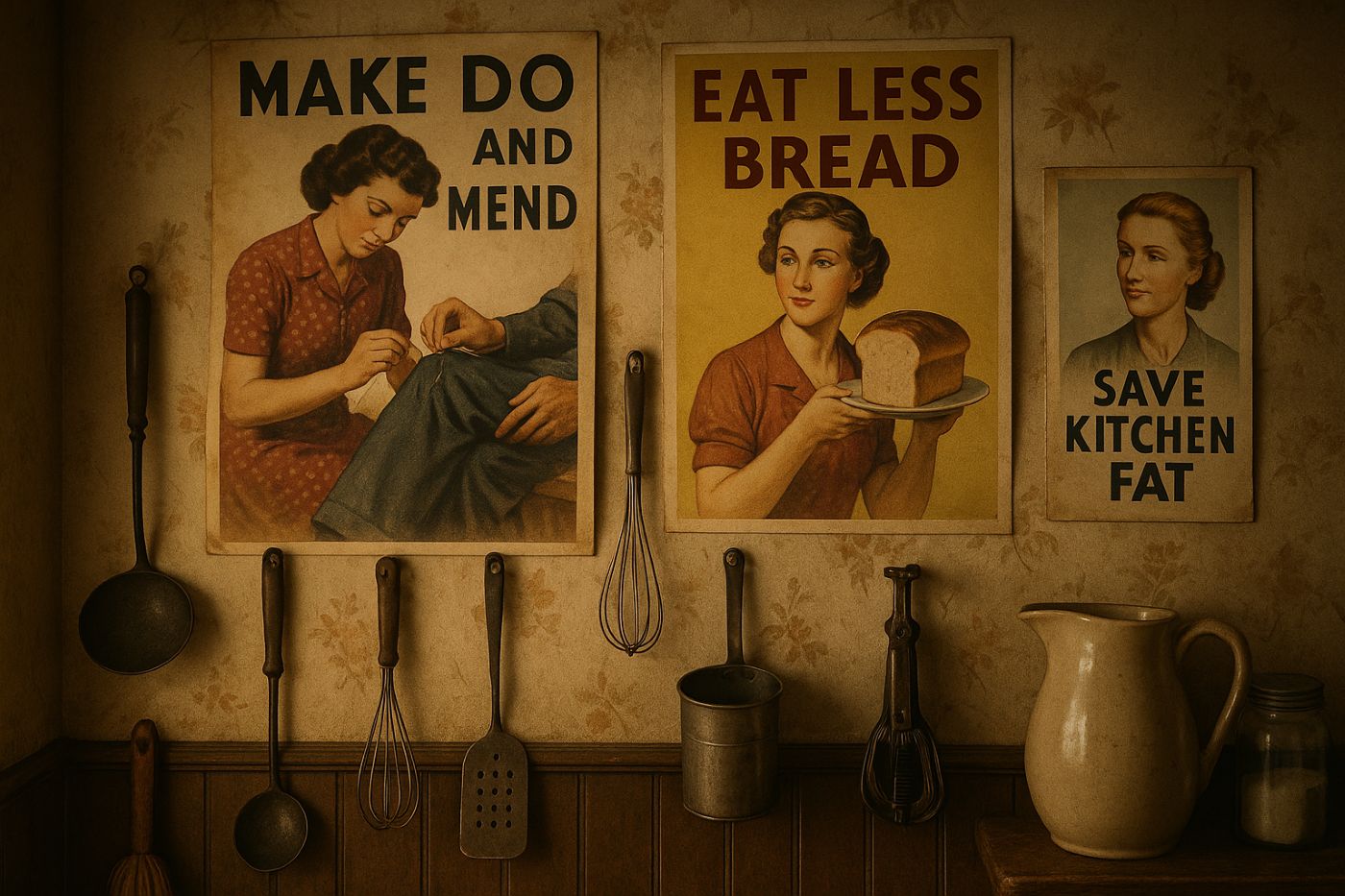
World War II rationing posters in a British kitchen
World War II rationing posters in a British kitchen
Imagine having to plan your meals when a week’s provisions consist of just a few slices of bacon, a dollop of butter, one single egg, and a can of mysterious meat. During World War II, that wasn’t a crazy fad diet – it was reality. Here are the unbelievable facts about World War II rationing.
In Britain, the typical weekly food ration for an adult was shockingly small: about 4 ounces of bacon, 2 ounces of butter, 8 ounces of sugar, 2 ounces of cheese, and 1 fresh egg (when available) per week – plus a tin of powdered eggs to make up for the lack of fresh ones1.
Yes, you read that right. Could you survive on those rations? Millions of people did.
And they didn’t just survive; they got creative with it, turning wartime scarcities into inventive (if not always appetizing) dishes. In this post, we’ll dive into how rationing worked, what folks actually ate on the WWII home front (in the UK, U.S., and beyond), and even challenge you with a real 1940s recipe you can try at home. Spam fritters, anyone?
Rationing 101: Why Food Was Scarce in WWII
When World War II broke out, it wasn’t long before everyday groceries became strategic supplies. Combatants needed enormous quantities of food for their troops, while enemy blockades and submarine warfare disrupted trade and farming.
The result? Rationing – government limits on how much of certain foods civilians could buy – to ensure everyone got a fair share of a shrinking pie.
In the United Kingdom, rationing began in January 1940, only a few months into the war1. German U-boats were torpedoing supply ships, and Britain, which imported much of its food, had to tighten its belt. The government issued ration books full of coupons, and households had to register with local shops – once you picked your butcher or grocer, you were generally stuck with them2.
Each person was allotted strict weekly amounts of essentials like meat, fats, sugar, and dairy. As the war went on, more and more items were added to the ration list. By 1942 almost every food was rationed except for fruits and veggies (you couldn’t exactly ration cabbages – though they were often in short supply too).
The idea was to guarantee everyone, rich or poor, could get at least some minimum of key foods. In practice, it meant a drastically limited diet. Long queues became a part of life, and it wasn’t uncommon to finally reach the shop counter only to find that day’s stock had run out.
In the United States, rationing kicked in a bit later, after America entered the war in 1941. The first major food to be rationed was sugar in the spring of 19423. (Imagine telling a 1940s American they had to cut back on apple pie – but patriotism ran high, and most complied.) Soon, coffee was rationed too – one pound every five weeks per adult, which works out to roughly a cup a day3.
Other items followed: meats, butter, canned goods, cooking oil, and more all came under ration limits for the duration of the war. The U.S. used a combination of coupon books and a point system.
For example, you might get a certain number of points to spend on canned or imported foods each month – a can of peas might cost you 8 points, a can of Spam maybe 5, etc. Once you ran out of coupons or points, that was it until next month.
The slogan was “Do with less, so they’ll have enough” – a call to sacrifice so that U.S. troops and allies (like Britain and the USSR) could be supplied. And while Americans’ rationing was strict, it was generally less punishing than what Brits endured.
After all, the U.S. mainland wasn’t under blockade – farms still produced plenty, and black-market goods didn’t command quite the same allure. Even so, items like gasoline and tires were severely rationed (to save rubber and fuel for the military), so civilians had to scale back driving and make do with what they had. Victory gardens – home vegetable gardens – were heavily promoted so that families could grow their own produce and take pressure off the food system.
Other countries had their own rationing systems too
Canada, Australia, and New Zealand rationed certain foods and goods to support the war effort (and their British allies). Germany and its occupied territories also lived under rationing, often much more severe as the war progressed – especially when food supplies dwindled and bombing devastated infrastructure.
In parts of Nazi-occupied Europe, ration cards were sometimes little more than cruel jokes; the official allotments could be starvation-level.
For instance, during the brutal Dutch “Hunger Winter” of 1944–45, the daily ration in cities fell to only 400–800 calories – people survived on things like tulip bulbs and even grass when fuel and food ran out4.
By comparison, the British and Americans (with their Spam and powdered eggs) almost had it good.
Spam, Powdered Eggs, and the Wartime Menu
So what did people actually eat during WWII? Let’s take a tour of the wartime menu, starting with the two headliners of this post: Spam and powdered eggs.
Britain: Keep Calm and Cook On (With Whatever You’ve Got)
Britain’s rations may have been meager, but they were consistent – and the Ministry of Food worked hard to help households “make the most” of them. A typical British meal in the 1940s was heavy on starches and vegetables, light on protein. Think: potato stew with a few bits of meat for flavor, or a vegetable pie bulked up with oats.
In fact, one famous dish, Lord Woolton Pie, was basically a hearty casserole of potatoes, carrots, turnips and whatever veg were on hand, baked under a crust of wholewheat pastry. It was named after the Minister of Food, Lord Woolton, and became a symbol of creative wartime cooking (even if not everyone was a fan of its bland, veggie-heavy taste).
Meat was tightly rationed – only about one average serving per person per week. To stretch what little they had, families filled up on things like beans, lentils, and cheese (when they could get it).
And then there was Spam.
Spam (the iconic canned spiced ham from Hormel) wasn’t actually rationed by coupon in Britain – it was a special import, provided by the USA as part of war aid. That meant if you could snag a can of Spam, you could eat it without sacrificing your meat coupon for the week5.
It’s hard to overstate how novel Spam was to Brits at the time – a salty, fatty, shelf-stable meat that didn’t require a butcher. For a population often missing bacon and ham, Spam was both a blessing and, eventually, a running joke.
British cooks tried it in every imaginable way: fried for breakfast, diced into stews, baked whole like a faux ham, and most famously Spam fritters (more on those in a bit!). The British public had a love-hate relationship with this “Yankee” meat. On one hand, it was a much-needed protein boost; on the other, there’s only so many ways to prepare Spam before you get thoroughly tired of it. (Indeed, soldiers sick of Spam rations would joke the name stood for “Something Posing As Meat” or even “Special Army Meat”6).
And what about eggs? Fresh eggs were scarce. By mid-1942, Britain limited eggs to about one per person per week1. Enter powdered eggs – dried egg powder, usually imported from the U.S., which came in big tins equivalent to a dozen eggs each.
Starting in 1942, each adult Briton could buy one tin of dried eggs every four weeks (children got two tins, since growing kids needed the protein)7. Officially, this was “extra” on top of your one fresh egg, but often the dried eggs replaced fresh ones entirely when chickens weren’t laying.
Now, if the idea of reconstituted egg sounds unappetizing, you’re not alone – many people were less than thrilled at the prospect. The government rolled out cheery propaganda to convince homemakers that dried eggs were real eggs in every way that mattered. “Nothing is added, nothing but the moisture and shell taken away,” assured one Ministry of Food poster, promising that dried eggs were just as wholesome and nutritious as the fresh-from-the-hen variety7.
Cooks were advised to use powdered eggs in baking or whip them into omelettes and scrambles. And truth be told, in recipes like cakes or puddings, dried eggs worked fine as an egg substitute. But eat them straight up as scrambled eggs? The result was often a rubbery, dull yellow impersonation of the real thing – technically egg, but not exactly appetizing.
Still, in wartime you took what you could get. Many a British child of the 1940s had their first “omelette” courtesy of dried eggs (perhaps sweetened with a bit of precious jam to make it go down easier).
With so many beloved foods in short supply, British cooks got extremely creative. The Ministry of Food published leaflets with recipes for “mock” dishes – imitations of foods that simply weren’t available. Craving roast meat?
You could make Mock Goose, a meatless loaf of seasoned lentils and breadcrumbs meant to mimic a roast goose (your imagination had to do a lot of work here). No cream for desserts? Whip up Mock Cream from margarine, sugar and a bit of flour to get a creamy filling for your cake.
Got a sweet tooth but chocolate and sugar are rare? Carrots to the rescue! Yes, carrots – British authorities pushed carrots as a sugar substitute since they have some natural sweetness. People started putting carrots in everything: carrot cakes, carrot puddings, even carrot “fudge” (a very loose interpretation of fudge made from boiled carrots, saccharin sweetener, and a bit of flavoring).
Kids gnawed on carrot lollipops – literally carrots on sticks – as a substitute for candy lollies5.
Unappetizing? Perhaps, but children who hadn’t seen real candy in years were happy enough for a crunchy, slightly sweet carrot treat.
Unsurprisingly, people got very tired of the monotony. One popular wartime saying was “Spam and eggs – and powdered eggs at that!”, uttered with a roll of the eyes at yet another lackluster meal. But despite the grumbling, the rationed diet kept the nation going.
In fact, nutritionists of the time noted that a balanced if plain diet plus vigorous daily activity actually left many Brits healthier than before the war (infamous sweet tooth and fry-up habits curbed by necessity). By war’s end in 1945, however, most were understandably eager to lift the restrictions and feast on forbidden delights like real butter, white bread, and as much meat as one could afford.
Unfortunately, Britain’s food shortages didn’t vanish overnight – rationing actually got tighter right after WWII. (Bread, never rationed during the war, had to be rationed in the late 1940s due to ongoing grain shortages!). It took nine long years after victory for Britain to finally end food rationing – meat was the last item to come off ration in 1954, marking the official end of the wartime diet8.
Imagine: nearly a decade of peacetime where families still had to queue up and count their bacon slices. Little wonder that when rationing ended, there were nationwide celebrations – and probably a collective prayer to never have to see a National Wheatmeal Loaf (the dense, brown “National Loaf” bread everyone was forced to eat) again.
United States: Coffee, Cake, and Creative Substitutes
On the other side of the pond, Americans were also rationing, though generally the portions were larger and the timeline shorter. The U.S. home front had more of many foods (thanks to America’s ample farmland), but shortages and shipping priorities meant common items could still be hard to get.
Sugar was a big one – U.S. imports of sugar plummeted after Japan overran the Philippines and cut off that supply in 1942. So the government limited sugar to about 8 ounces per person per week – half of pre-war consumption3.
For the nation of apple pies and Coca-Cola, that was a tough adjustment! Home bakers learned to use corn syrup, honey, or molasses in recipes, and cakes that required little sugar or no eggs became popular (the famous “War Cake” or “Victory Cake” was made with zero butter, zero eggs, and minimal sugar – relying on spices and raisins for flavor).
Coffee was rationed too, to one pound every five weeks as mentioned, due to U-boat activity and priorities shipping to troops3. One can imagine the collective national caffeine withdrawal. Many an American of the 1940s got used to weaker coffee, or chicory blend coffee, or simply going without their second cup.
Meat and dairy were rationed by a points system in the U.S. If you wanted a steak or a pound of hamburger, you had to turn in red ration points along with the money. The system was complex – different cuts of meat or types of butter/margarine “cost” different points depending on availability.
Butter was scarce (and needed for troops), so many households reluctantly switched to margarine – which at the time came white and uncolored, with a separate little packet of yellow food dye you had to mix in if you wanted it to look like butter. (The diary lobby in some states actually prohibited selling pre-dyed margarine to protect butter sales!).
Cheese, canned milk, oils – all these were rationed as well3. Fresh milk was prioritized for kids and pregnant women. And like Britain, the U.S. encouraged everyone to grow Victory Gardens in backyards and empty lots, to supplement rationed food with home-grown veggies.
By 1943, millions of Americans were gardening – and proud of it. Canning and preserving home produce became a patriotic hobby (with the government providing handy guides on how to can foods safely).
Despite the limits, the American wartime table wasn’t quite as bleak as Britain’s. Many foods like fresh vegetables, fruit, fish were not rationed (if you could find them). And the variety of products in the U.S. was greater – for example, while British children dreamed of a banana (a fruit virtually nonexistent there during the war), Americans still had access to citrus and bananas from Latin America for part of the war (though these imports did slow down).
Still, by 1945 even Americans were dreaming of a return to uncontrolled eating. Rationing in the U.S. ended sooner than in Britain – most restrictions were lifted in 1946, with only sugar persisting into 19473. The collective sigh of relief was palpable.
One interesting side-effect of U.S. rationing and GI innovation: some new recipes and food combinations emerged that later became classics. A famous example is the legend of Spaghetti Carbonara – while the true origin is debated, one story is that Italian cooks in 1944 improvised a pasta dish for American soldiers using their rationed bacon and powdered egg yolks, tossing them with local pasta and cheese to create what we now know as carbonara.
Whether entirely true or not, it illustrates how wartime necessity could spark culinary creativity that outlasted the war.
And of course, Spam was a part of the American diet too – though perhaps more famously part of the G.I. diet overseas. Hormel’s Spam was a staple in U.S. military rations, and countless soldiers got sick of eating it for breakfast, lunch, and dinner. (There’s an old quip attributed to soldiers: “We could undoubtedly survive on these rations a lot longer than we’d care to live”9 – in other words, you can live on canned meat and dry biscuits indefinitely, but you might not want to!)
The U.S. sent huge quantities of Spam to Allies as well. All told, over 150 million pounds of Spam were purchased by the U.S. military during WWII to fuel the Allied armies10. It went everywhere: Pacific islands, European battlefields, the Arctic convoys.
Soviet Russia, in particular, benefited from American Spam sent via Lend-Lease – after the war, Soviet leader Nikita Khrushchev even acknowledged, “Without Spam, we wouldn’t have been able to feed our army.”10 (If that isn’t an endorsement for canned lunch meat, I don’t know what is.) Back home, civilians could buy Spam with ration points, and many did when other meats weren’t available.
It wasn’t always beloved – even stateside, jokes circulated about what Spam really stood for, with wags calling it “Scientifically Processed Animal Matter” or “Spam, Spam, Spare me another can!” – but it sure did help keep people fed when fresh meat was scarce.
By war’s end, both Brits and Americans were thoroughly bored of rationed fare. But the experience left a lasting legacy. People had learned to grow their own food, not to waste scraps, and to cook with ingenuity.
Cooking from scratch became second nature (you couldn’t rely on pre-packaged foods – they were rare). And some wartime inventions stuck around. That quick, eggless chocolate cake recipe (sometimes called “Wacky Cake” or “Depression Cake”) which uses vinegar and baking soda to rise?
It’s still a beloved recipe today because it’s moist and delicious – who needs eggs! And Spam… well, Spam never really went away. It became a cultural icon of its own. Famously, decades later in 1970, Monty Python’s Flying Circus did a comedy sketch in which a café serves “Spam, Spam, Spam, Spam” with everything on the menu11.
The sketch exaggerated how ubiquitous (and unwanted) Spam had been – and it was so popular that it even inspired the modern use of the term “spam” for unwanted email. Not bad for a humble wartime meat tin!
Time-Traveling in Your Kitchen: Recreating a WWII Ration Recipe
Enough talk – ready to taste the 1940s? For a fun (and eye-opening) challenge, try cooking this genuine World War II recipe. It’s a simple dish that British families made when they managed to get their hands on that precious can of Spam and wanted to stretch it into a filling meal. Let’s make Spam Fritters, 1943-style. 🥘
During the war, Spam fritters became a bit of a comfort food in the UK – a way to make a treat out of canned meat by frying it in batter. Schools even served Spam fritters for lunches, and they remained a nostalgic favorite for some Brits long after the war.
The original wartime recipe is extremely basic (since eggs and milk were scarce for the batter). We’ll stick close to authenticity here. Don’t worry, you can always doctor it up with spices or a fancy dipping sauce after you’ve tried the plain version!
The Verdict: Could You Survive on Wartime Rations?
After exploring the ration era, you might be thinking: “Alright, people did it back then… but could I survive on Spam and powdered eggs today?” It’s a great question to ponder next time you open a well-stocked fridge or order takeout without a second thought. Surviving, as in physically getting enough to eat and staying healthy – the answer is yes, you probably could. The WWII ration diets were carefully designed by nutritionists of the era to provide essential calories and nutrients (albeit just barely). Many who lived through those years later remarked that despite monotony and occasional hunger, they didn’t actually starve – and some came out of the war healthier than before, due to reduced sugar and fat intake and an increase in vegetables and whole grains. You would have to adjust your expectations: less sugar, fewer snacks, more bland fillers, and a lot of home cooking and conserving every scrap. It would be a bit like voluntarily adopting a super simple “peasant diet” and a zero-waste kitchen routine. Could a modern Gen Z or Millennial used to Starbucks and UberEats handle it? Perhaps – though we might see some epic Twitter rants about the lack of pumpkin spice lattes!
That said, “surviving” is one thing, and “living” is another. The truth is, people in the war years deeply missed the abundance and variety of peacetime. They got through it by reminding themselves it was for a good cause – and by finding humor where they could. (As the wartime joke above suggests, living on these rations might keep you alive longer than you’d want to live on them9!) When the war ended, nobody was nostalgic for powdered eggs. But the experience did instill a lasting appreciation for the little things – a real banana, a slice of ham thicker than a razor, a cake with actual icing. Ask anyone who grew up in the 1940s, and they’ll tell you how unbelievable it felt to taste those first post-war luxuries.
So, could you survive on Spam and powdered eggs? Give that Spam fritter recipe a whirl, and you’ll get a small taste (literally) of what it was like. You might find it fun for a day – even tasty – but by week two of Spam-for-breakfast-again, you’d likely be daydreaming about pizza and fresh greens and a nice frothy milkshake. The WWII generation wasn’t inherently tougher because of some magic trait; they were made tougher by circumstances, by necessity. They coped and adapted because they had to. And if push came to shove, so would we. Let’s just be glad we don’t have to.
Next time you’re frustrated by a supply chain delay or a grocery store running out of your favorite brand of chips, think back to the 1940s and remember how people rationed, recycled, grew their own food, and made weird recipes just to get by. It’s a remarkable story of resilience and creativity – with a side of humor (and Spam).
Sources & Footnotes:
- Stephen Wilson, “Rationing in World War Two,” Historic UK (Culture UK Magazine). Describes the start of British food rationing in January 1940 and lists a typical weekly ration for one adult (e.g. bacon 4 oz, butter 2 oz, sugar 8 oz, 1 egg, etc.). ↩ ↩2 ↩3
- Imperial War Museum, “What You Need to Know About Rationing in the Second World War,” IWM.org.uk (History article). Explains the rationing system in Britain, including the requirement that civilians register with specific retailers for rationed goods and use government-issued coupon books. Basic foods like meat, sugar, butter, bacon, and cheese were rationed via coupons, while other items were controlled by a points system. This ensured an equitable distribution but also meant long queues and frequent shortages by the time one reached the shop counter. ↩
- U.S. National Park Service, “Food Rationing on the World War II Home Front,” NPS.gov (article). Provides an overview of American rationing between 1942–1945. Confirms that sugar was rationed from May 1942 (initially 12 oz per week, later 8 oz) and was the first and last food item rationed (stayed rationed until 1947). Also notes coffee rationing at one pound per 5 weeks per adult (later 1 lb per 6 weeks), and outlines other rationed foods (meat, butter, canned goods, cheese, etc.) and the use of point systems and coupon books in the US. ↩ ↩2 ↩3 ↩4 ↩5 ↩6
- Dorothea Föcking, “The Dutch Hunger Winter 1944–45,” Environment & Society Portal (Rachel Carson Center, 2016). Describes the famine in German-occupied western Netherlands during winter 1944-45. Notes that adult daily rations fell to 400–800 calories and many people resorted to eating tulip bulbs and other inedible substitutes to survive. An estimated 22,000 people died during this “Hongerwinter.” This stark example shows how much more severe conditions could be outside of the managed Allied rationing systems. ↩
- Michael Denham, “As We Once Were: Wartime Rationing,” British Geriatrics Society – Our Heritage (2015). Recounts how Britons were encouraged to get creative with food substitutes. Examples include “mock” recipes like mock cream (made from margarine, milk and cornflour) and mock goose (lentils and breadcrumbs), using carrots to replace sugar in desserts (carrot fudge, apricot tarts), and even children eating carrots on sticks as make-believe ice lollies. Also notes that American Spam became a mainstay item in the British diet during WWII. ↩ ↩2 ↩3
- Blake Stilwell, “Hormel Kept a ‘Scurrilous’ File of Hate Mail About Spam from World War II GIs,” Military.com (June 30, 2022). Shares anecdotes about soldiers’ attitudes toward Spam. Lists some of the joking acronyms and nicknames coined by American GIs, such as “SPoiled hAM,” “Stuff, Pork and hAM,” and the darkly humorous “Scientifically Processed Animal Matter.” It also notes that troops cynically dubbed Spam “Special Army Meat,” highlighting both its ubiquity in their rations and their weariness of it. ↩
- C. N. Trueman, “Dried Eggs,” History Learning Site (2015). Details the introduction of dried egg powder in Britain in 1942 as a supplement to the egg ration. Notes that one tin contained the equivalent of 12 eggs (an extra ~3 eggs per week) and includes a Ministry of Food poster assuring that “dried eggs are the complete hen’s egg…with nothing added, nothing but the moisture and shell taken away.” ↩ ↩2
- Imperial War Museum, “Rationing Ends – 1954,” reference from IWM archives. Confirms that British food rationing continued after WWII and finally ended in 1954, when meat and bacon – the last remaining rationed foods – were taken off ration (nearly nine years after the war). Britain’s Ministry of Food, which managed rationing, was disbanded later in the 1950s after over a decade of overseeing the nation’s controlled food supply. ↩
- Mary Roach, Gulp: Adventures on the Alimentary Canal (W.W. Norton & Co., 2013) – via Goodreads quote. In chapter 12, Roach cites a 1964 US Army research paper by food scientist Samuel Lepkovsky, who reflected on WWII field rations. Summing up soldiers’ feelings about monotonous canned meals, Lepkovsky quipped: “We could undoubtedly survive on these rations a lot longer than we’d care to live.” (In other words, the food would keep you alive, but you wouldn’t enjoy life on it – a sentiment many wartime civilians would understand too!) ↩ ↩2
- Howard Fischer, “Saving the starving Soviets with Spam,” Hektoen International (Journal of Medical Humanities, Jan 2024). Discusses the crucial role of Spam in WWII. Mentions that the United States military purchased 75,000 tons of Spam during the war to feed U.S. and Allied troops. Also quotes Soviet Premier Nikita Khrushchev’s memoir, which noted “Without Spam, we wouldn’t have been able to feed our army. We had lost our most fertile lands,” underscoring Spam’s importance in the Soviet wartime diet when their own food production was crippled by the war. ↩ ↩2
- “Spam (Monty Python sketch),” Wikipedia. Describes the famous 1970 Monty Python comedy sketch in which a café menu is dominated by Spam in every dish. The sketch’s popularity cemented Spam’s cultural image as an ever-present (and somewhat comical) food, and it later inspired the internet slang use of “spam” to mean repetitive, unsolicited messages (echoing how the sketch repeated the word “Spam” ad nauseam). ↩