History of Eva Braun: Victim, Villain, or Something Else Entirely?
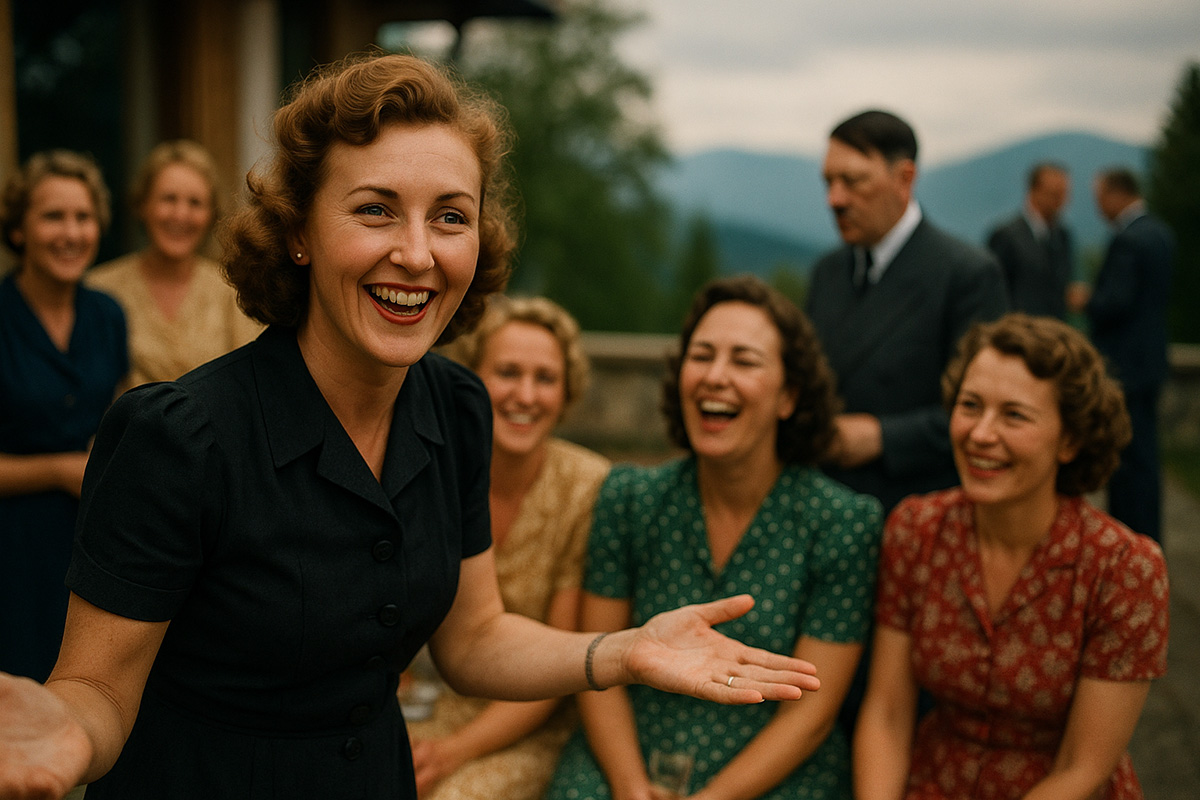
Eva Braun entertaining guests at Berghof with Hitler in the background
Eva Braun entertaining guests at Berghof with Hitler in the background (created with AI)
Eva Braun: The Woman Who Chose a Life with Hitler
Eva Braun – The Woman Behind the Monster (Kind Of) – is one of the most shadowy—and strangely sanitized—figures in 20th-century history. She’s known for one thing: being Adolf Hitler’s longtime companion. Not his political ally. Not a major player. Just… there.
But how do we make sense of someone who spent over a decade at the side of the world’s most infamous dictator—yet barely spoke publicly, never held office, and left behind mostly films of sunbathing and dogs?
Was she a clueless bystander? A quiet enabler? A deeply apolitical woman caught in history’s darkest orbit? Or something more complex?
Let’s unpack the strange, often contradictory history of Eva Braun.
Who Was Eva Braun, Really?
From Catholic Schoolgirl to Companion of the Führer
Eva Anna Paula Braun was born on February 6, 1912, in Munich, into a respectable Catholic middle-class family. Her father was a schoolteacher, her mother a seamstress. By all accounts, her early life was unremarkable — church-going, modest grades, and a flair for fashion and sports. She was neither rebellious nor politically engaged. She was, in short, an ordinary young woman in an extraordinary moment in history.
At age 17, a young Eva Braun started working as an assistant and model at the photo studio of Heinrich Hoffmann — who just happened to be Hitler’s official photographer and close confidant. It was there, in October 1929, that Eva Braun met Adolf Hitler. She reportedly referred to him as “Herr Wolf”, his early pseudonym, and thought him somewhat stiff and strange. But he was already powerful — and charismatic in private.
What followed was a slow-burning, carefully managed relationship. Hitler, 23 years her senior, kept their connection secret for years. Braun, meanwhile, found herself drawn into his orbit, first emotionally, then physically — and finally, entirely. By her early twenties, her world was already shrinking around him.
Understanding this beginning helps explain the rest. Eva Braun wasn’t “born into” evil — but she chose to stay at its center, long after she understood what it was.
A Life of Leisure, Isolation, and Photographs
Braun spent most of her adult life in a peculiar half-reality: surrounded by luxury, yet utterly constrained. She skied, sunbathed, and filmed the Nazi elite in color with her 16mm Agfa camera. She was obsessed with movies and fashion. She loved dogs and long baths. And she was deeply, aggressively apolitical—at least on the surface.
She also attempted suicide twice in the early years of their relationship. Many historians believe this was tied to Hitler’s emotional distance and his refusal to acknowledge her publicly. After the second attempt, he became more attentive. Their relationship continued—deeply imbalanced, emotionally fraught, but steady.
The Apartment in Munich: Hidden in Plain Sight
While Eva Braun spent much of her time at Hitler’s mountain retreat, Berghof, she also lived in Munich — but not just anywhere. Hitler
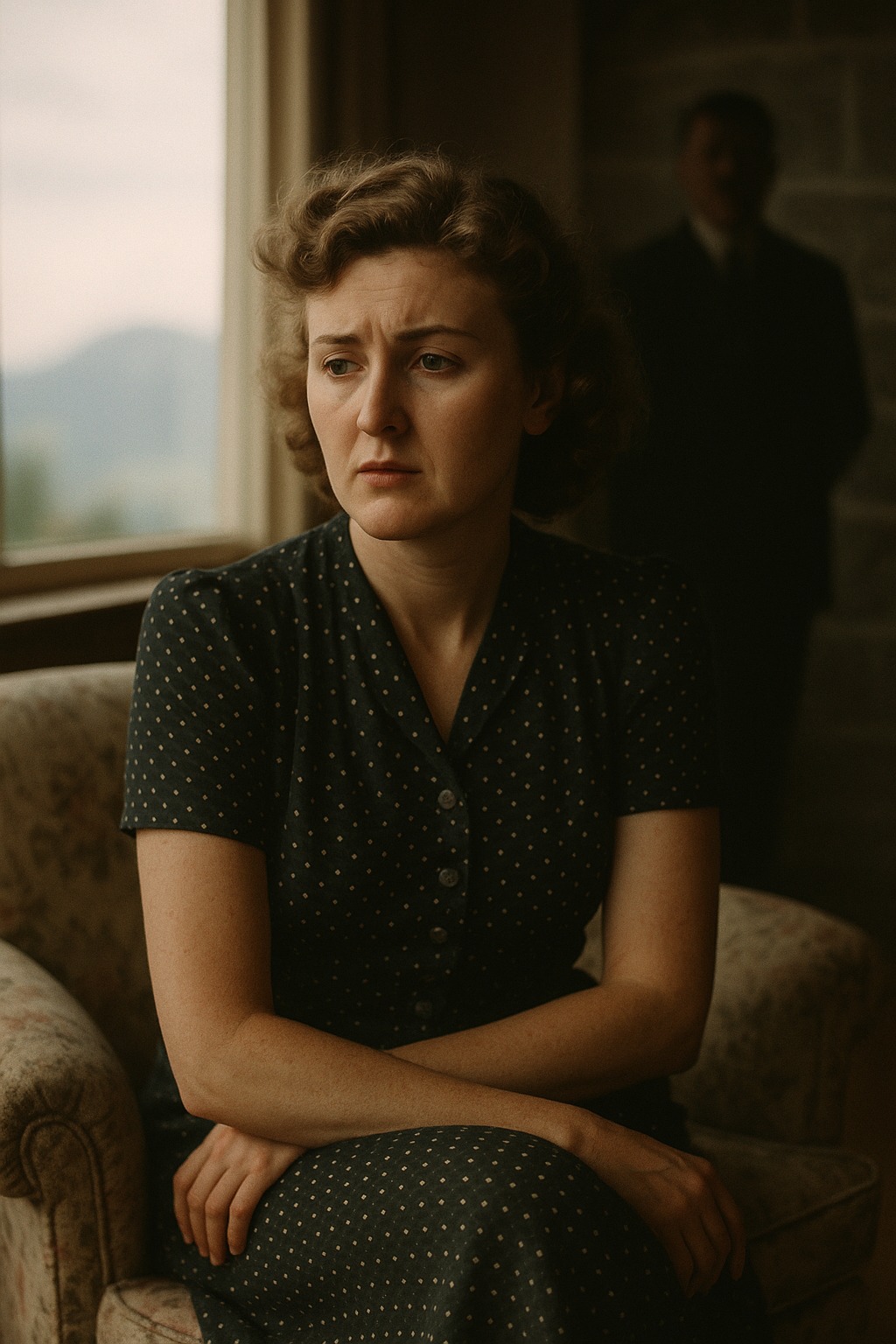
Eva Braun was not always happy living with Hitler (created with AI)
arranged for her to have her own private residence: first a modest apartment, then later an upscale townhouse-style flat at 12 Prinzregentenplatz, not far from his own official address.
This wasn’t a romantic getaway or a sign of independence. It was a calculated setup — comfort without visibility. Hitler was obsessed with maintaining the image of a chaste, self-sacrificing leader married to the German people. Eva, meanwhile, was kept out of sight but within reach.
Her Munich apartment was luxuriously furnished and paid for by Hitler. She had a maid, a chauffeur, and access to anything she wanted — except public acknowledgment. The setup speaks volumes: she wasn’t hidden because she was unimportant, but because acknowledging her would damage the myth.
This living arrangement — secretive but lavish — perfectly sums up Eva Braun’s role: a private companion in a regime obsessed with public image, tucked into the margins of history but deeply entangled with its core.
Tea, Sunbathing, and Soft Power: Eva Braun’s Wartime Social Life
Though rarely seen in public, Eva Braun played a central role behind the scenes at the Berghof. She wasn’t a political actor — but she was a social one. The Berghof wasn’t just Hitler’s Alpine hideaway; it was a rotating stage for generals, Nazi officials, foreign visitors, and loyal friends. And Eva was often the hostess.
She organized afternoon teas, birthday celebrations, film nights, and casual outdoor gatherings for Hitler’s inner circle. Guests were entertained with long walks, banter over cake and champagne, and even home movies filmed by Eva herself. Her presence added an air of domestic normalcy — as if genocide wasn’t being orchestrated one floor above.
Photos and memoirs describe sun-drenched terraces, flower arrangements, laughter over coffee. Eva even recorded some of these scenes on her personal 16mm Agfa camera — the footage now preserved as eerie glimpses of Nazi leisure.
These gatherings weren’t trivial. They helped build a sense of community and comfort among top Nazi officials, humanizing each other in ways that dulled moral boundaries. Eva wasn’t making military decisions, but by helping create a social bubble of denial and intimacy, she became part of the psychological machinery that made evil feel ordinary.
What Did She Know?
Denial or Willful Ignorance?
This is the heart of the debate. Eva Braun wasn’t in the Nazi inner circle in a political sense, but she was certainly surrounded by its top brass: Himmler, Göring, Goebbels, Bormann. She lived at Berghof while Hitler planned campaigns and atrocities. She heard the war unfold in real time. She had access to everything—and responsibility for nothing.
Some biographers argue that Braun remained deliberately ignorant of the Holocaust, choosing not to ask questions. Others believe she had a basic understanding, but compartmentalized it to protect her identity as “just a woman in love.”
But there’s no evidence she ever objected, questioned, or spoke out.
What Eva Braun’s Diaries and Letters Say
The history continues: Eva Braun’s surviving letters and diaries are surprisingly mundane. She writes about hair appointments, new shoes, how bored she is at Berghof. Occasionally, she gushes about “Adi” (Hitler’s nickname). She doesn’t reference politics or war crimes. But the absence speaks volumes.
In one 1944 entry, she complains about shortages in makeup and chocolates—at a time when Germany was bombing London and starving Jewish ghettos.
Was she oblivious? Possibly. Was she choosing oblivion? Probably.
The Final Act: Loyalty to the End
In April 1945, with Soviet troops surrounding Berlin, Eva Braun made her only political statement: she chose to die with Hitler. She joined him in the Führerbunker, married him in a short civil ceremony, and committed suicide the next day.
She was 33. Her entire adult life had been shaped by one man—and she chose to end it beside him.
Victim, Villain… or Historical Footnote?
Why She Still Fascinates Us
Eva Braun wasn’t a mastermind, a war criminal, or a revolutionary. But she remains compelling because she sits at the blurred edges of responsibility. She wasn’t powerful—but she wasn’t powerless. She was close enough to see everything—but chose not to look too closely.
She forces us to ask uncomfortable questions:
- How much should someone be held accountable for what they don’t do?
- Can you live inside evil without actively participating in it?
- Is loyalty to a monster a moral crime?
Modern Interpretations (and Misreadings)
Pop culture has sometimes painted Braun as a tragic figure—lonely, naive, doomed by love. But this view risks sanitizing her proximity to horror. Other portrayals go too far in villainizing her, imagining a Lady Macbeth figure without real evidence.
In truth, Eva Braun was not extraordinary. And maybe that’s the most disturbing part: someone so ordinary, so culturally unremarkable, could exist at the very core of unspeakable horror.
So… What Was She?
A victim of Hitler? Yes, in some ways. A willing enabler? Also yes. But more than anything, Eva Braun was a participant in passive form—someone who chose comfort, denial, and personal devotion over conscience.
To say it simply: If Eva Braun were a bagel, she’d be a plain bagel — with expensive cream cheese.
She’s not a puzzle piece that fits easily into history’s moral categories. But that’s why she matters.
Sources
- Heike B. Görtemaker, Eva Braun: Life with Hitler
https://www.penguinrandomhouse.com/books/214354/eva-braun-by-heike-b-gortemaker/ - Smithsonian Magazine – What Eva Braun’s Home Movies Reveal About Hitler
https://www.smithsonianmag.com/history/what-eva-brauns-home-movies-reveal-about-hitler-128407/ - The Guardian – Eva Braun: Hitler’s Devoted Companion
https://www.theguardian.com/world/2010/oct/29/eva-braun-hitler-biography-review - History Today – The Secret Life of Eva Braun
https://www.historytoday.com/archive/secret-life-eva-braun - BBC – What Do Eva Braun’s Photos Really Show?
https://www.bbc.com/culture/article/20140804-eva-braun-life-in-hitlers-inner-circle